If a neighborhood name can tell a story, Paradise Valley Farms says a lot in just three words. It hints at open land, rural roots, and a very different Scottsdale than the one many buyers picture today. If you are trying to understand why this pocket of 85258 feels more like a collection of private estates than a typical subdivision, the answer is in its history, lot pattern, and evolution over time. Let’s dive in.
Paradise Valley Farms Is In Scottsdale
One of the most common points of confusion is the location itself. Despite the name, Paradise Valley Farms is identified in Scottsdale documents as being in Scottsdale 85258, not in the Town of Paradise Valley. A 2024 Scottsdale planning report places the subdivision at 8003 N 75th St within Scottsdale and designates it within the city’s Rural Neighborhoods framework.
That distinction is useful if you are researching the area or comparing neighborhoods nearby. The name reflects regional identity and history, but the subdivision itself is part of Scottsdale. For buyers and sellers, that helps clarify how to think about the neighborhood in the context of local planning and property research.
Development Started In The Late 1960s
Paradise Valley Farms is not a new luxury enclave that appeared all at once. Scottsdale records show the subdivision right-of-way was dedicated by plat in July 1967. The city’s historic subdivision study places much of its construction around 1968, 1970, and 1973.
That timeline helps explain the neighborhood’s character today. It began during Scottsdale’s postwar era, when single-family neighborhoods were expanding, but it developed with a lot pattern that was notably more spacious than many other subdivisions. In other words, the framework was set decades ago for the estate feel people notice now.
Lot Sizes Help Define The Estate Feel
If you want the clearest reason Paradise Valley Farms feels different, look at the parcel sizes. Scottsdale’s historic subdivision study gives the neighborhood an average parcel size of about 49,000 square feet, which is just over one acre. In a city where lot sizes in postwar developments could vary widely, that is a major differentiator.
Recent neighborhood sales reinforce that point. Reported sales in Paradise Valley Farms have included lots of about 0.76, 1.07, and 1.55 acres. When you combine that scale with mature landscaping and lower-density spacing, the neighborhood reads less like a standard tract subdivision and more like a custom estate pocket.
Why Large Lots Matter In Scottsdale
Large lots change more than just the numbers on a listing sheet. They affect how a property lives, how a home is positioned on the site, and how much separation you may feel from neighboring homes. In an area like Scottsdale, that extra land can also support more expansive footprints, outdoor amenities, or long-term redesign potential, depending on the property.
Scottsdale’s historic themes report notes that larger lots were often found in areas north and west of the canals, especially where former agricultural plots and intentional low-density planning influenced development. Paradise Valley Farms fits naturally into that pattern. Its lot structure is part of the reason the neighborhood still feels distinct today.
Architecture Evolved From Ranch Homes To Estates
The neighborhood’s visual identity also reflects Scottsdale’s broader postwar housing story. The city’s historic housing themes describe many older single-family neighborhoods as ranch-oriented, often with single-story homes, low-pitched roofs, patios, block or stucco walls, carports, and strong indoor-outdoor planning. Those features remain an important part of the area’s architectural DNA.
At the same time, Scottsdale’s historic studies note that upscale builder and custom homes often had broader footprints, more exterior detailing, and a wider range of materials and styles. That helps explain why Paradise Valley Farms now presents as a mix of renovated ranch homes and custom rebuilds. It is a neighborhood where the original framework still shows, but many properties have evolved into something larger and more design-driven.
Today’s Homes Reflect Reinvestment
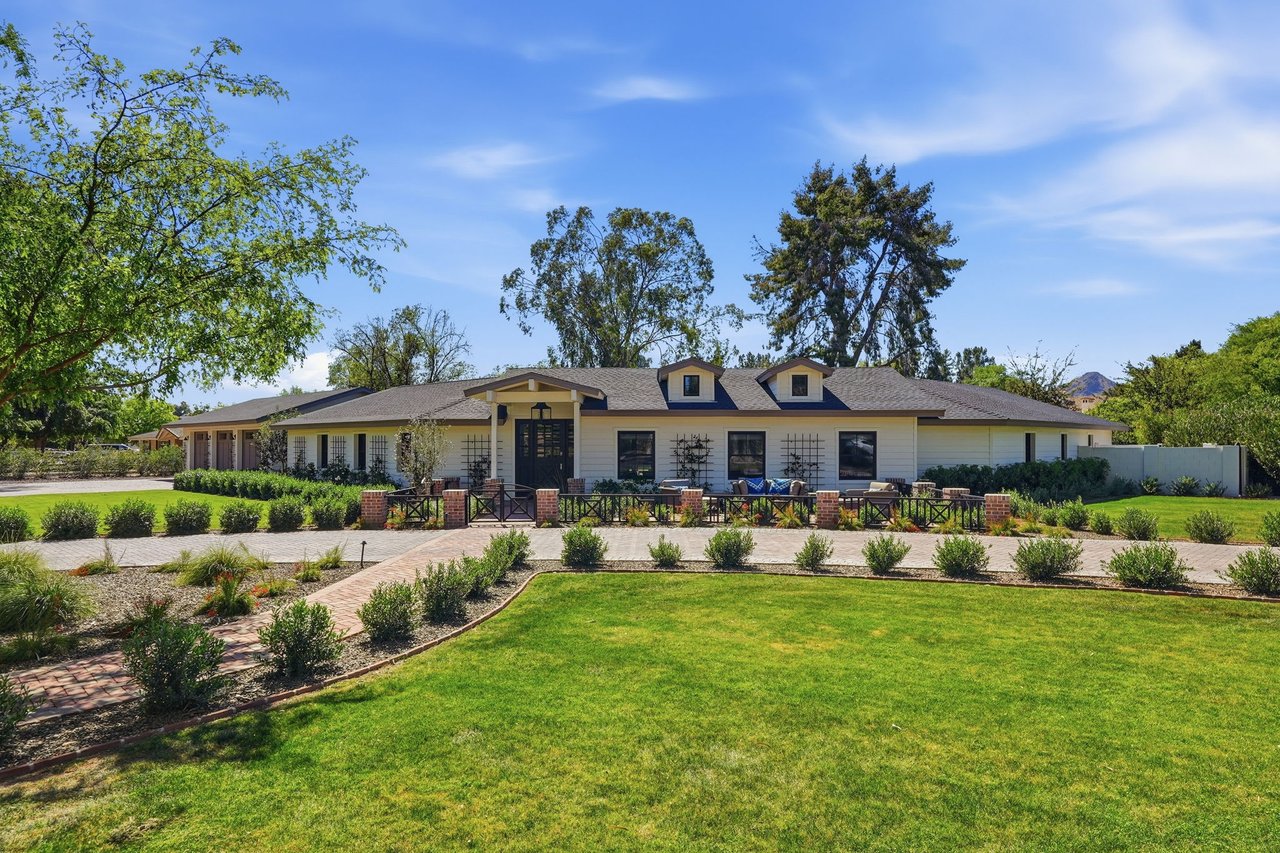
Recent market activity gives a practical view of how that evolution looks on the ground. A current listing in the neighborhood described an original 1968 home that was completely rebuilt in 2018 with modern farmhouse character, high-end finishes, and lush landscaping. That kind of transformation is consistent with what buyers often see in mature Scottsdale neighborhoods with oversized lots.
For some properties, the appeal is the legacy ranch-style home with updates. For others, it is the opportunity to own a substantially reimagined residence on a parcel that would be difficult to replicate in many newer neighborhoods. In both cases, the lot remains a major part of the value story.
Mature Landscaping Adds Presence
A big part of Paradise Valley Farms’ appeal is not just the house itself, but the setting around it. Scottsdale’s historic themes report notes that some postwar developments benefited from flood irrigation, which supported lush vegetation, and that neighborhoods built on former agricultural land sometimes preserved existing citrus trees. The same report also notes FHA guidance that called for two front-yard trees in new single-family homes.
Those patterns help explain why older Scottsdale neighborhoods can feel greener and more established than buyers expect. In Paradise Valley Farms, mature trees and established landscaping contribute to the neighborhood’s quiet estate character. The result is often a softer, more rooted streetscape than what you find in newer planned communities.
The Equestrian Influence Is Still Part Of The Story
The word “farms” in the neighborhood name can lead people to assume every property functions as a horse property, but that would be too broad. A more accurate reading is that the area retains some equestrian and rural cues tied to its history and physical layout. Scottsdale states that it generally does not regulate the number of horses or other farm animals on single-family and two-family residential properties when they are for personal use and there is a habitable home on the lot, though county rules and CC&Rs may also apply.
A 2024 Scottsdale planning report involving Paradise Valley Farms also referenced a public non-motorized access easement that transitions to an existing equestrian easement trail. That does not mean every lot is set up the same way, but it does show that horse-oriented infrastructure still exists in and around the subdivision. For buyers who appreciate a rural thread within Scottsdale, that is a meaningful part of the neighborhood’s identity.
What Buyers Should Notice In Paradise Valley Farms
If you are considering a home in Paradise Valley Farms, it helps to focus on the features that truly set it apart:
- Parcel scale that often reaches around an acre or more
- A lower-density setting shaped by rural and agricultural history
- A mix of original ranch-era homes and custom rebuilds
- Mature landscaping that adds shade, privacy, and visual presence
- A Scottsdale location in 85258 with a distinct identity from surrounding neighborhoods
- Equestrian context in the area, though property-specific rules and conditions still matter
For design-conscious buyers, this combination can be especially appealing. You are not just buying square footage. You are buying land, setting, and a neighborhood pattern that has become increasingly rare.
What Sellers Should Understand About Positioning
If you own in Paradise Valley Farms, your property story should be told with more nuance than a standard neighborhood summary. Buyers are often responding to a layered value proposition that includes lot size, architectural potential, maturity of landscaping, and the neighborhood’s unusual blend of rural roots and estate presence. That takes thoughtful positioning.
This is where local market knowledge matters. In neighborhoods like Paradise Valley Farms, pricing and presentation are not only about recent comparable sales. They are also about understanding how buyers assign value to land, improvements, design quality, and long-term scarcity.
Why This Neighborhood Still Stands Out
Paradise Valley Farms stands out because it carries forward an older Scottsdale pattern that many buyers still want but cannot easily find. Its late-1960s framework, generous lots, ranch-era origins, and ongoing reinvestment have created a neighborhood that feels established, private, and highly individual. It is one of those places where the land tells as much of the story as the homes do.
If you are buying or selling in a neighborhood like this, details matter. Understanding how history, parcel size, architecture, and positioning work together can shape better decisions and better outcomes. If you are considering a move in Paradise Valley Farms or elsewhere in Scottsdale’s luxury market, The Estates Office offers discreet, market-informed guidance grounded in lot value, design context, and strategic execution.
FAQs
Where is Paradise Valley Farms located in Scottsdale?
- Paradise Valley Farms is located in Scottsdale 85258, and Scottsdale planning documents identify it as part of Scottsdale rather than the Town of Paradise Valley.
How large are lots in Paradise Valley Farms?
- Scottsdale’s historic subdivision study lists an average parcel size of about 49,000 square feet, and recent sales have included lots from about 0.76 to 1.55 acres.
When was Paradise Valley Farms developed?
- Scottsdale records show the subdivision right-of-way was dedicated in July 1967, with many homes constructed around 1968, 1970, and 1973.
What types of homes are found in Paradise Valley Farms?
- The neighborhood includes ranch-era homes tied to Scottsdale’s postwar development history, along with renovated properties and larger custom rebuilds on generous parcels.
Does Paradise Valley Farms have an equestrian connection?
- Yes, the area retains equestrian context, and a 2024 planning report referenced an equestrian easement trail, though property-specific use is still subject to city rules, county rules, and CC&Rs.
Why does Paradise Valley Farms feel like an estate neighborhood?
- Its estate feel comes from large lots, lower-density planning, mature landscaping, and the evolution of many properties from ranch-era homes into more expansive custom residences.