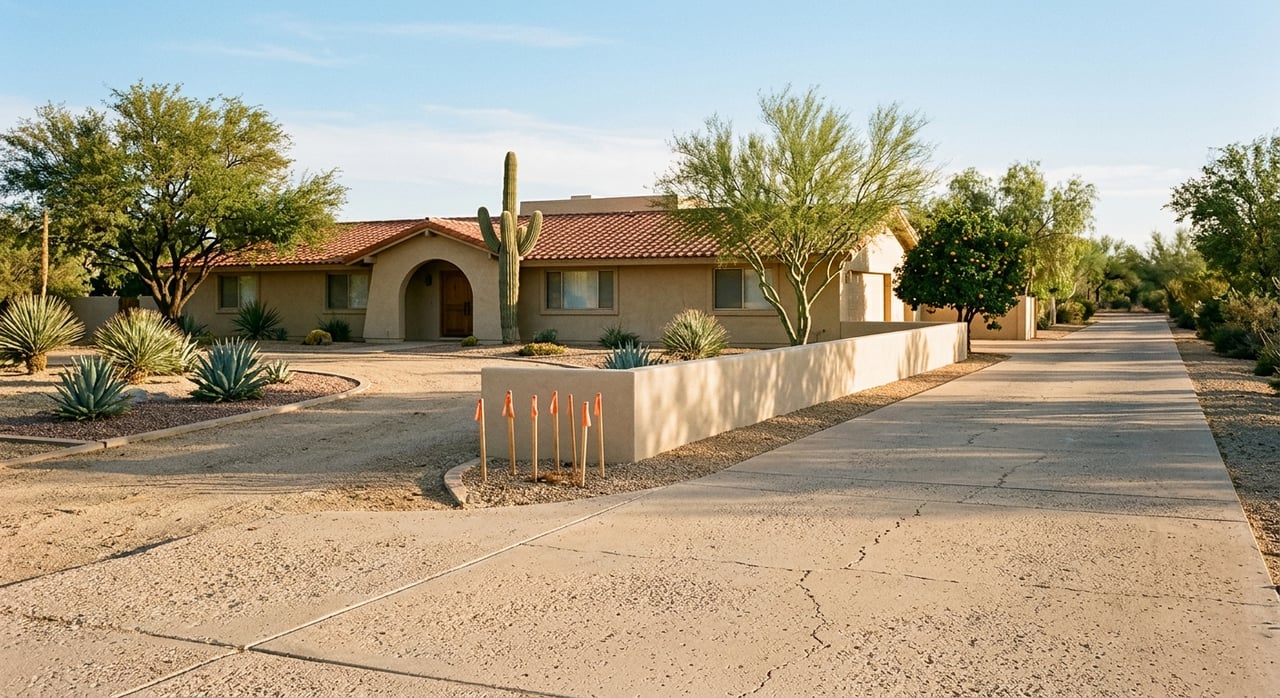
Wondering whether your Paradise Valley property should be marketed as a home, a renovation candidate, or simply as land? That question matters more here than in many other markets, because teardown value in Paradise Valley often comes down to what the site can support, not just what the current house looks like. If you are weighing a sale, the right strategy can help you protect value, reduce wasted time, and attract the right buyer from the start. Let’s dive in.
Why teardown sales work differently
In Paradise Valley, a teardown sale is often a land-use story first. The town’s 2022 General Plan emphasizes its primarily one-acre residential character, along with preserving open space and natural features.
Most of Paradise Valley is zoned for single-family use with one home per lot. The town requires at least 43,560 square feet in R-43 and 35,000 square feet in R-35, although some older parcels remain legal nonconforming lots because they were under one acre when annexed.
That framework shapes how serious buyers think. If nonresidential uses require special use permit approval after public hearings and are handled case by case, then a seller usually gets farther by presenting the property as a site opportunity within the town’s rules, rather than trying to sell a buyer on an outdated floor plan.
What makes a property a teardown
A teardown is not just an older home with dated finishes. In practice, the question is whether the market sees more value in the lot and future build potential than in the house as it stands today.
The Appraisal Institute’s highest and best use framework looks at the land as if vacant and asks whether a use is physically possible, legally permissible, financially feasible, and maximally productive. For you as a seller, that means the discussion should center on the parcel itself.
Buyers and appraisers will often focus more on factors like:
- Lot size and configuration
- Access and driveway approach
- Views and topography
- Setbacks and easements
- Drainage conditions
- Utility availability
- Demolition cost
- Hillside constraints, if applicable
If the current house has meaningful functional issues or obsolescence, that can further support a land-driven pricing approach. In other words, the structure may carry less weight than the site beneath it.
The market rewards disciplined pricing
Even in a high-end market, strategy matters. Over the three months ending May 2026, Redfin reported that Paradise Valley was not very competitive, with a median sale price of $4.45 million, median days on market of 91, a sale-to-list ratio of 94.6%, and price drops on 42.1% of homes.
That does not mean strong properties cannot sell well. It does mean that overpricing a teardown, or marketing it to the wrong audience, can cost you time and leverage.
For a teardown sale, buyers are often underwriting future use, risk, and cost. If your pricing ignores demolition, site work, entitlement uncertainty, or physical constraints, the market may push back quickly.
Your three main selling paths
Sell as-is for land value
This is often the cleanest option when the structure is functionally obsolete, the lot is especially compelling, or the most likely buyer is a builder, developer, or custom-home end user. In that scenario, trying to force the home into a traditional resale narrative can distract from the real value.
An as-is strategy can also simplify your process. Instead of spending heavily on upgrades with uncertain payoff, you position the property around what matters most: the parcel, the build envelope, and the path to redevelopment.
To support that approach, it helps to prepare a strong property file. Useful materials may include:
- Survey
- Title review
- Easement information
- Utility information
- Known topographic conditions
- Any hillside or drainage constraints
The more clearly you can show what a buyer is acquiring, the more credible your asking price becomes.
Make modest improvements before listing
Not every older Paradise Valley property should be sold strictly as dirt. Some homes still have enough appeal to reach a broader luxury buyer pool, especially if the deficiencies are cosmetic rather than structural or functional.
That is where selective preparation can make sense. A focused refresh, such as paint, cleanup, landscaping, or limited repairs, may improve presentation without pushing you into a full renovation that the market will not reward.
The key is to treat upgrades as a financial decision, not an emotional one. If a modest spend helps the property compete in a better price tier or makes it easier for a buyer to understand the opportunity, it may improve your net result.
If those dollars do not move the property closer to its maximally productive use, they may simply add cost without adding value. In teardown situations, restraint is often smarter than over-improving.
Pursue limited entitlements before sale
Sometimes the best value play is not in the house or even in the raw lot as currently understood. It may be in clarifying a specific upside before you go to market.
In Paradise Valley, that could mean exploring a lot split, variance, setback adjustment, access change, or other entitlement-related work. The town requires a Planning Pre-Application before most entitlement, zoning, or building permit approvals, including zoning relief and lot-split requests.
The planning portal identifies common submittal items such as:
- ALTA survey
- Legal description with gross and net acreage
- Grading plans
- Drainage plans
- Other supporting site documents
Still, this path is not automatic. The town’s cluster-plan article makes clear that approvals in the relevant residential districts are discretionary, not granted as a matter of course.
That means you should weigh the likely upside against the time, cost, and uncertainty of the public process. In some cases, proving a credible path to greater utility can raise buyer interest. In others, the better move is to let the next owner take on that work.
Permits and reviews buyers will care about
A teardown sale in Paradise Valley is not just about list price and photos. Sophisticated buyers want to know what approvals they may need, what constraints may affect timing, and what site work may be required.
Demolition itself is directly regulated. Paradise Valley requires a demolition permit when more than 12 linear feet of wall or fence, or 12 square feet of roof structure, will be removed, and that permit must be obtained before a building permit is issued.
Site disturbance can trigger county requirements too. Maricopa County requires a dust control permit for activity disturbing 0.1 acre or more.
If your property is on a hillside parcel, the review process may become more detailed. The Hillside Building Committee reviews new construction for land disturbance, building heights, lighting, building materials, and grading and drainage in order to preserve the hillside.
The town also notes that hillside projects may require:
- A construction staging plan
- Financial assurance
- Right-of-entry or temporary construction easement agreement
- Staked limits of construction
For a seller, the practical lesson is simple. The more clearly you can show what may be built, what may need review, and what may affect timeline, the stronger your marketing package becomes.
How to position your property well
A strong teardown listing in Paradise Valley should do more than describe the existing residence. It should help a buyer quickly understand the site, the constraints, and the opportunity.
That usually means building your sale strategy around facts, not assumptions. The right positioning often starts with a careful review of zoning, lot dimensions, access, easements, topography, and any known permit or hillside considerations.
From there, your presentation can be tailored to the buyer most likely to pay a premium. For one property, that may be a land buyer focused on redevelopment. For another, it may be a luxury buyer willing to enjoy the home now and improve later.
In a market where pricing discipline and preparation matter, a teardown sale tends to perform best when the value story is clear from day one.
If you are considering selling a Paradise Valley teardown, The Estates Office brings local land, luxury resale, and development perspective to help you evaluate the right path, prepare the property intelligently, and position it with discretion.
FAQs
What makes a Paradise Valley home a teardown instead of just outdated?
- A property is better viewed as a teardown when the site’s highest and best use appears more valuable than the current home, based on factors like zoning, lot size, access, topography, easements, and redevelopment potential.
Should you make repairs before selling a Paradise Valley teardown?
- Sometimes, but only if modest improvements help the property reach the right buyer pool or price tier without overspending on updates the market is unlikely to reward.
Can you seek a lot split or zoning relief before selling in Paradise Valley?
- Possibly, but Paradise Valley requires a Planning Pre-Application for most entitlement, zoning, or building permit approvals, and outcomes can still be discretionary.
What permits matter when selling a Paradise Valley teardown property?
- Demolition permits, Maricopa County dust control permits for larger site disturbance, and hillside-related reviews or requirements can all affect buyer planning and timeline.
What should buyers review when evaluating a Paradise Valley teardown lot?
- Buyers commonly focus on zoning, lot dimensions, setbacks, access, views, easements, drainage, utilities, topography, demolition cost, and whether hillside review may apply.
Who should help you plan a Paradise Valley teardown sale?
- Because these sales can involve pricing, land-use, engineering, permit, tax, and financial considerations, it is wise to work with real estate, land-use, tax, and financial professionals as you choose your strategy.